Sheila K Miller, COVID-19 Compliance Officer, New Media Journalist
 Traveling during the COVID-19 pandemic can be confusing. Every state developed a reopening plan and requirements to keep their citizens and visitors safe. In an AARP article, Jan L. Jones, professor of hospitality and tourism at the University of New Haven in Connecticut, says, “There is no consistent message across the states, and that’s extremely difficult for travelers. I can’t even navigate it.”
Which state requires travelers quarantine? Where do I can I find traveling information? What “reopening” phase is a state in? Those are some questions being asked by travelers and more. Read further for some of those answers to Maryland, Virginia, West Virginia, and District of Columbia with resource links.
Is Self-Quarantining or Testing Required?
In the D.C., Maryland, Virginia, and West Virginia region, the District of Columbia is the only government requiring self-quarantining after traveling from 29 states while in phase 2 of their reopening. While Maryland does not require self-quarantining or a negative test, it does strongly recommend for a traveler to take such actions if traveling to those states or regions with a ten percent or higher rate of COVID-19 positive tests. As of September 13, the CDC reports ten states with an 11 – 20 percent daily increase in positive tests. West Virginia and Virginia do not require any quarantining or testing requirements. However please note, Virginia currently has an 11 – 20 percent increase of daily positive cases per CDC.
For all other states check with individual state, local, territorial, or tribal governments for the most updated travel restrictions. As of October 19, CNN reported that 18 states, including the District of Columbia, require or strongly advised self-quarantining for 14 days or a negative COVID-19 test before or after arrival. (See the map above.) The general rule of thumb is: if traveling from a state with a ten percent or more increase of positive new cases daily, self-quarantine or a negative test result may be required. For example, New Jersey’s Are There Travel Restrictions to and from New Jersey? lists travel from 41 states requiring a 14-day self-quarantine. Depending on which state, the penalty for failing to quarantine or produce a negative test can range from $0 to $25,000.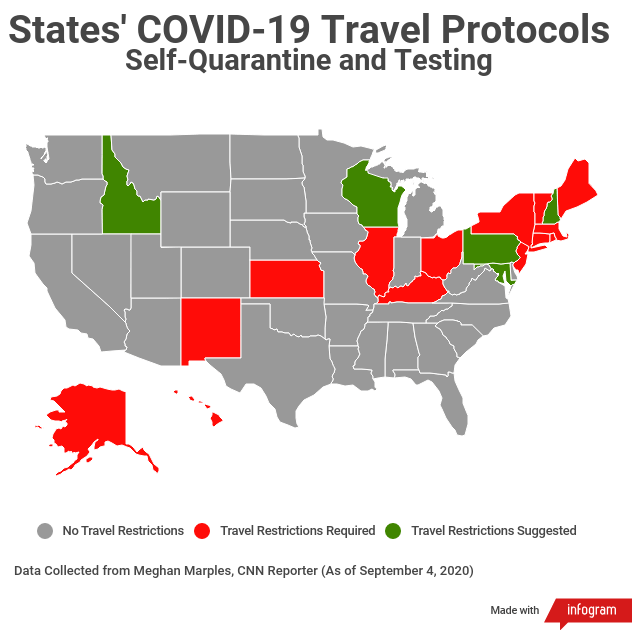
Click HERE for an interactive map
COVID-19 Travel Precautions
There are precautions a traveler can take before, during, and after a trip to prevent the spread of COVID-19 and lower the chance of contracting COVID-19. The following suggestions are mainly compiled from the CDC.
Prior to travel, you can:
- Check the state’s new cases in the last seven days using the CDC COVID Data Tracker;
- Check state, territorial, tribal, and local health department websites for travel requirements.
- Anticipate your needs while traveling, i.e., masks, hand sanitizer, decide if you will disinfect your hotel rooms; pack food and water in case restaurants are closed.
During travel be sure to:
- Wear a mask in public.
- Maintain at least 6 feet distance between people.
- At bathrooms and rest stops, wash hands with soap and water after using the facilities and being in a public place.
- When getting gas, use a disinfectant wipe or wear disposable gloves. Then use hand sanitizer with at least 60% alcohol.
- When staying at a hotel, wear a mask when in the lobby or communal areas; and ask what other precautions the hotels are taking (plexiglass barriers, staff wearing masks, and updated policies for cleaning and disinfecting). For example, Best Western’s historic Rail Haven Motor Court Inn uses an electrostatic disinfectant fogging machine in addition to its regular cleaning and disinfecting practices.
- Use drive-thru, curbside pickup, or contactless delivery when eating at restaurants.
After travels you should:
- Check with your state and local governments for recommendations and requirements after travel.
- Self-quarantine for 14-days and get tested for COVID-19.
- Social distance during the quarantine period including household members.
- Wear a mask in public and around high-risk family members.
- Wash your hands often.
- Be vigilant of any COVID-19 symptoms you maybe develop. Take your temperature if you feel sick.
These recommendations and resources can help to minimize your risk of contracting COVID-19 and the spread of the virus. Be safe and vigilant, especially when traveling.